So since I’m pretty sure my last post got me onto several federal watchlists and I still need more time to try and dissect the plot from character driven stories, today we’ll be focusing on something new: minimalist storytelling, and why I think the video games are the first medium that can really unlock their potential. First though, what is minimalist storytelling?
A minimalist story is a story where both plot and character take a backseat; stories that are more about depicting a specific experience than actually telling a specific story. James Joyce’s Ulysses is a good example of minimalist storytelling because there’s not really much of a “story” to it, as such. Instead you simply experience the day-to-day thoughts and actions of the characters in the book. Most of these thoughts and actions are quite mundane, with character’s describing how they feel about the food they’re eating or the weather or most of the minutia we all think about. More recently, The Road by Cormac McCarthy was very minimalist, though certainly not to the extent of Ulysses. The Road, simply put, is a brutal and realistic tale of survival in a post-apocalyptic world. We don’t even learn the character’s names, they are simply the Boy and the Man.
Minimalist storytelling is able to tell some unique stories that a heavy plot or character development would otherwise inhibit. The Road is pretty unique, showing us mankind reduced to its most basic instincts as the man and boy try to survive in a world that is no longer inhabitable. The only backstory we really get is a bit of exposition about the Man’s wife committing suicide. Had the Road gone with a more traditional story, going through a blow by blow description of how the apocalypse occurred or a long storied background for each of the characters, the Road would probably have turned out much like the dozen other apocalypse stories out there. Of course the problem is that, by its very nature, minimalist storytelling is sometimes difficult to read and watch.

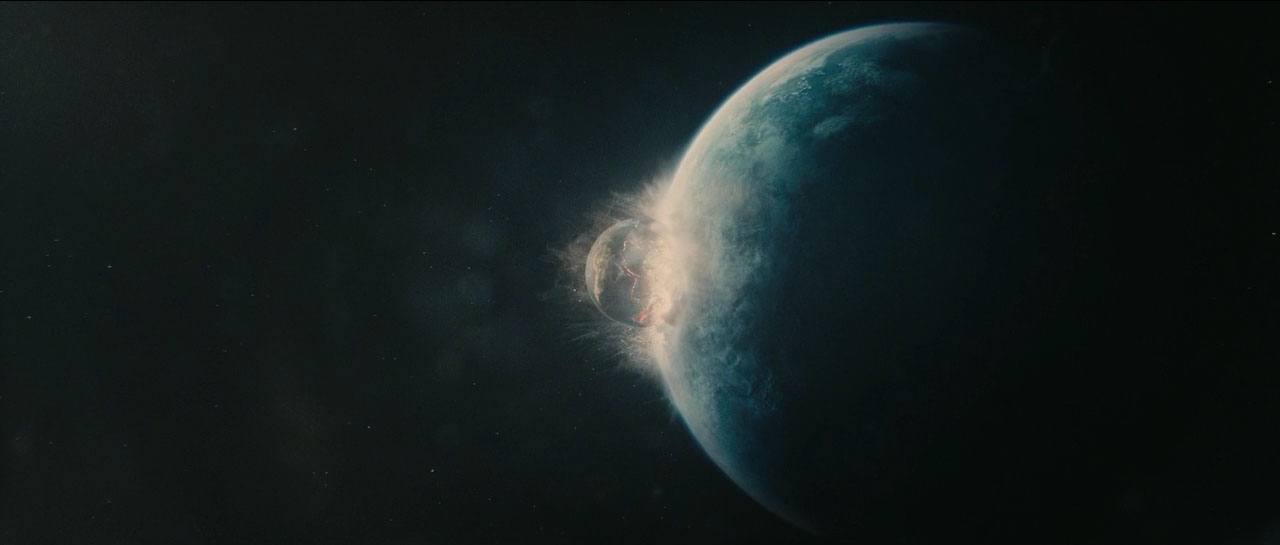
Ulysses is one of the most difficult to read books in existence. I’ll admit right now that I never did complete Ulysses, and most people who try experience the same difficulty. The Road was commercially successful only because it wasn’t completely minimalist like Ulysses, we still got some characterization of the boy and man, and there was still a coherent plot even if it was bare bones (survive and move south was basically the whole plot). However, you can look at minimalist movies like Tree of Life or Melancholia to see that most people don’t really want to watch those kinds of movies. Critics tend to like these movies because they’re film lovers; they can enjoy the unique film making strategies like cinematography, acting, and that sort of thing. To them, the story doesn’t matter.
For most people though, we want to be told a story. It’s just human nature because, after all, we’re all storytellers in a way. When you describe how your day was to your friend or partner, you’re telling them a story. It might be based on facts, but that doesn’t make it any less of a story. You arrange your story into a coherent form, whether chronologically or by how important different events were, and then tell it as a first-person narrative. We embellish, or sometimes outright lie, to make our stories more interesting to our listener. It’s the same thing we’ve been doing since our stupid, hairy ancestors gathered around a fire and told stories of how “dude, I just totally punched a sabertooth tiger in the mouth today.” Or something like that. Point is, we like stories and we like the characters we hear about and relate with, minimalist storytelling is just a very difficult concept for our minds to process. There’s no real character or plot to help us structure the story, rather the story just comes at us and we need to make sense of it ourselves. I’ll admit that I usually end up hating most of the “arty” minimalist movies that come out. Melancholia, I thought, was a terrible movie in almost every respect except the superb acting. Same with Tree of Life.
However, while minimalist stories struggle to survive in books and movies, some of the absolute best video games I’ve ever played have all had minimalist stories. Video games have become more than just something to waste time with at the local arcade. In fact, far from being a brain atrophying disease like some old pundits would have us believe, video games have opened a whole new medium to tell unique stories that we would not otherwise be able to tell. It might be very well the only medium that can make a minimalist story successful and accessible to a wide audience. For example, here are two of my favorite games that all feature minimalist stories:
2. Shadow of the Colossus
One of the most well known and well regarded games in video game history, this adventure/puzzler/action game took a very minimalist approach to telling its story and succeeded in making that story emotionally engaging on top of it.
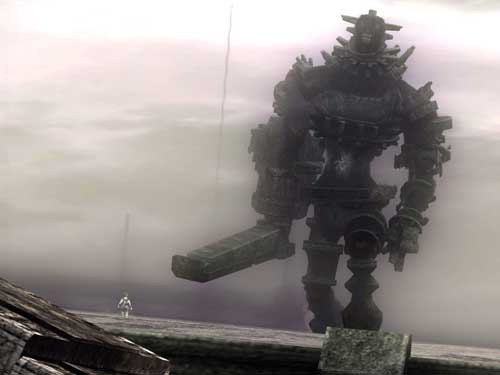
Shadow of the Colossus features a young man trying to ressurect his dead girlfriend: yawn. Who cares right? I mean that’s a story that has been told so many times its just gotten old. That’s what I thought too, until Shadow of the Colossus took my preconceptions, pounded them into the dirt, and turned that dirt into diamonds. We don’t get overwrought shakespearean soliloquies from the main character about the death of his beloved, in fact we get very little dialogue of any kind. Instead, a mysterious God instructs you to kill the gigantic creature known as Colossus, of which there are many. These creatures range from towering behemoths of stone, to elegant bird-like forms that sweep through the air like eagles.
Then of course, there’s your faithful horse Agro, your only companion in the game and one of the most memorable characters I’ve seen in a video game, precisely because it’s a horse. This game came out in 2005 as well, so they couldn’t rely on HD graphics to realistically portray a horse either. I mean I’m a sucker for a horse’s eyes, even video game horse eyes look emotional and its easy for me to fall prey to actually caring about a bunch of pixels and code. However Shadow of the Colossus made you care about Agro through making her an integral part of the gameplay; the main character and the horse were sharing their journey. You needed Agro to help take down Colossi, solve puzzles, and travel the vast distances of the game world. She was important to you. And then, just as Agro becomes like family to you, after you’ve taken down countless Colossi and survived every hazard the game can throw at you, this happens (1:30):
I was reaching out right along with the main character, I loved that god damn horse. The rest of the climb to face the final Colossus was one the loneliest moments in the game. You succeed of course, destroying the final Colossus, returning home to get your reward: the woman you love. Of course it also ends up that the “god” you’ve been helping is actually a demon, and the Colossi were keeping it trapped….the Colossi that are now just so much rubble thanks to you. Now I already saw this coming, but what I didn’t see coming was that I would have to play the part of the demon.
The game actually forces you to take control of the demon, and I admit it’s kind of fun to crush the foolish mortals who try to stop you. Then, however, the monk escapes and creates a white swirling vortex that begins sucking the demon into it. Slowly the black form of the demon is swept away, and only the main character remains, and this was the greatest moment in the entire game:
The video doesn’t make it apparent, but you’re still controlling your character as he’s struggling against the vortex. After everything you’ve done, all the hardship you’ve survived and the enemies you’ve defeated…so close to the one thing you want…and they let you control it. I nearly broke my controller apart trying to fight the vortex, struggling to reach the far end of the room…clawing desperately to get a happy ending. The guy in the video doesn’t struggle against it because the inevitable truth is that you can’t escape. No matter what you do, you always get sucked into the vortex. You’re pulled in: defeated at the threshold of victory…
But then the girl wakes up. Our old friend Agro shows up, limping and clearly in a lot of pain, but alive. The two things you care about most in the world are now left to live out the rest of their lives in peace….you succeeded, even if you didn’t live to see it.
Hang on…I’ve got something in my eye…
1. Half-Life 1 & 2
This is perhaps the best example of how video games can tell a minimalist story that is still compelling and exciting. In fact it was Half-Life that first showed me the exciting potential of video games as a storytelling tool. You start off as Gordon Freeman, a theoretical physicist working in a top-secret facility called Black Mesa and…well that’s it really. You’re given no other information whatsoever. You meet some scientists whose names you never learn, you encounter aliens whose motivations are never explained (at least not upfront), you wander through strange experimental laboratories as you try to escape the facility. On the surface, Half-Life seems to have have no story.
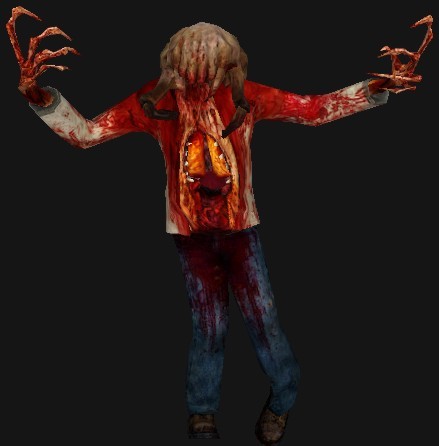
However, and it’s a big however, as you progress through the game more and more of the story is slowly revealed to the player. Sometimes you don’t even know it’s there, and that’s what makes it great. In a video game you want the player to retain as much control as possible, we tend to get annoyed when control is taken away from us. In video games, a minimalist story is also an unobtrusive story, it is perhaps tailor made to use minimalist stories. I first played Half-Life when I was like 12 or 13 years old, so I was mostly into it for the fun of blasting aliens with shotguns. When I play through it now though, I can see the story that Half-Life is telling simply by observing the environment. For instance, at first glance you might think all of the aliens in the facility are just different types of soldiers sent to the invasion, but if you look carefully and observe before shooting, you can see the different enemies actually fighting each other. Eventually you come to understand that these are just animals from a different world; they’re not invading so much as they’ve been pulled into our world by an experiment gone wrong.
I didn’t even bother to look at the aliens who shoot green electricity, I didn’t much care as long as they were dead. However, if you do look close you can see green bracelets around their neck and arms. Are they ornamental? Some form of alien weapon? Or are they some kind of restraint?
And then there was the enigmatic G-man: a man in a business suit who appears seemingly at random in various areas in the game. He doesn’t interact with you (until the end anyway), instead he seems to simply be observing you. Despite the fact that hundreds of people have been slaughtered in this facility, this harmless looking man isn’t even mussed. No blood on his jacket. He moves deliberately and calmly. And somehow he’s alive, even though he possesses no apparent weapon. All of this adds up to one thing: this man is clearly not who he appears to be. The game doesn’t tell you this, and in fact its possible to go through the game and completely miss over half of his appearances. Its only through the player’s deductions can we come to the conclusion this man is something…different.
That’s the great thing about minimalist storytelling in a game, it encourages you to actively seek out answers rather than simply handing them over to you. In a book or movie that can be frustrating because you’re limited to what you’re being shown through text and images, but in a game we can move around and explore. We can examine. We can investigate.

I will say that Half-Life’s minimalist storytelling does begin to fall apart during the final levels of the game on Xen, the alien homeworld, and this is the danger of minimalist storytelling in games as well. Because it’s the game environment itself that is telling the story in Half-Life, if that environment starts getting half-assed, the story starts going downhill right along with it. At the conclusion of Half-Life we’re met with a thoroughly uninteresting environment, pieces of rock hovering in mid-air, most of the textures are a bland brown, and the final battle is thoroughly mundane, playing out like the final villain in an arcade game. We should have been greeted with the sight of an alien homeworld that actually looks like it could sustain the life we’ve seen throughout the game, wandering through strange forests and watching these beasts in their natural habitat. Seen remnants of their civilization, collapsed buildings or strange writing. Something. To Valve’s credit, however, they learned from this mistake and brought us back into the story with the excellent Half-Life 2.
Half-Life 2 did have a few more story elements than Half-Life 1; we had a pair of wonderful characters to relate with this time, Eli Vance and his daughter Alex. We had a more tangible enemy with clearer motivations in the Combine and their puppet leader Dr. Breen. We even had a pet Dog.

However, even though it wasn’t quite as minimalist as its predecessor, Half-Life 2 still told most of its story through the environment around you. After a bone-chilling introduction by the G-man, we’re thrust onto a train heading for City 17. What city 17 is…we don’t know. Why did the G-man place us here? How many years have passed since Half-Life 1? These are all questions that are answered through the game’s environment.
As soon as we get off the train, everything from Dr. Breen’s crooked smile on the TV screen to the drab blue uniforms of the citizenry tells us that this city is not a place of freedom or happiness. The faceless guards wearing strange uniforms begin abusing people as soon as they step off the train. Walking outside we see a massive metal spire shooting up from the ground which is clearly not of human design. You may not even realize it at the time, but just through the environments themselves, we have been given a ton of information:
1. The results of the Black Mesa incident clearly had long reaching consequences, and are the most likely reason for the circumstances we see in the game.
2. Some kind of alien species has assumed control of Earth, probably through military force.
3. Earth is now a conquered planet. Everything we know about our Earth no longer applies here.

Those three facts convey to the player all the information they need to know; the rest they can find out for themselves. If you really pay attention you can see vaguely cyrillic looking characters on some of the buildings, which if you a history buff, you’ll recognize as having a very Soviet/Warsaw-pact design to them: functional, yet not made for comfort or aesthetics. All of that points to the fact that we’re somewhere in Eastern Europe or possibly Russia. There are several levels that feature rivers, oceans and locks…and all of them look as if the water level is much too low…and that it has been low for quite some time. Beached ships miles away from a water source are common sights, as are canals that have clearly been dry of water for long enough that people have taken up permanent residence in them.
Why would the water be lower? Is that why these aliens are here? Draining the planet of all its natural resources, including H2O?
Half-Life 2 is absolutely dense in terms of story, with so many elements that it boggles the mind. Look at this timeline. Half-Life is a story that features interdimensional wars, strange and seemingly omniscient creatures capable of altering space-time as we know it, and particle physics that defy understanding. In fact, in the overall scheme of Half-Life’s canon, makinds enslavement and fight for freedom is relatively small part. A critical part, but still small. I honestly don’t know how else you could tell the story of Half-Life in any other way than a minimalist approach, as Valve did. If you try to fit all that information into expository dialogue or long winded speeches, you’d just confuse the hell out of everybody.
Valve’s solution to their dazzlingly complex story line is as elegant as it is simple: let the player unravel the story at his own rate. The story is there for you to find, but it is spread out in such a way that we can slowly put these varied and confusing pieces together into a coherent form in our own minds. They’re basically letting us tell the story to ourselves; after all, we’re all storytellers. Who’s more qualified to tell us a story than ourselves?


 The Writer's Block
Leave a reply to jmstevenson Cancel reply