

That’s the question on everyone’s mind. Or at least it was the question on my mind when I finally finished Bioshock Infinite, and if your mind doesn’t work like mine then frankly I don’t want to know you.
Since understanding what the hell is going on is integral to being able to understand the narrative and the wonderful nuances behind it, I’ve decided to make that the first article in this series. I’m going into this assuming you played through the game, it helps if you’ve played through it twice but isn’t obligatory. Since Bioshock: Infinite gives no definitive answers to anything, almost everything is open to interpretation, so the following includes a lot of speculation on my part but I’ve pieced together the story as accurately as I can.
Lutece and the Beginning

The first time I played through Bioshock Infinite the Lutece twins didn’t appear that important to the story, and in fact I thought they were a bit of a deus ex machina when they revealed the trick to controlling Songbird. Upon a second playthrough though, and after much reflection on the story, the Lutece twins are actually critical to the story. Much of the action that unfolds during the game is a direct result of their actions and there’s a reason they’re the first characters we meet in the game: they are the ones who began this story.
The beginning of Bioshock Infinite isn’t really the beginning of the story and part of the reason the game’s narrative is so hard to follow at first is because we’re only seeing a small piece of the story. The true beginning revolves entirely around Lutece and her discovery of quantum particles, the theoretical technology that allows Columbia to float and allows the interdimensional travel that dominates the game’s setting. From what I’ve been able to piece together, Lutece’s discovery and subsequent harnessing of the quantum particles is the inciting incident that sets off the entire story. After all, without a floating Columbia and the ability to see into future realities, Comstock would have been just another cult leader that would have faded into obscurity.
The actual sequence of events is more difficult to piece together, was this before or after the Wounded Knee massacre, did Comstock find her first or did she find him. There are countless questions, but regardless of the answers, it’s clear that eventually Lutece needed further funding in order to continue her work. Either Comstock or the US government grants her that funding, leading her to a practical application for her quantum particles and the creation of Columbia. Whether it’s Comstock that directs Lutece to begin research into opening interdimensional windows, or it was Lutece’s idea and Comstock just later found a way to corrupt it, I don’t know. Regardless, it’s while experimenting with this technology that Lutece meets her brother.
Except it’s not her brother in the traditional sense, but rather herself from a different reality where the sperm that impregnated her mother’s egg carried a Y chromosome instead another X.

Eventually Lutece succeeds in bringing her “brother” from the other universe and the two begin their strange love-affair with quantum physics, completely uncaring that they’re working for a monster so long as their scientific curiosity is sated. As we all know, this comes to bite them in the ass later down the road.
Comstock uses Lutece’s experiments to see “visions” of the future and cement his god-like position as The Prophet of Columbia. Much like Marie Curie when she discovered radium, though, neither Comstock nor the Luteces understand the dangers of the radiation being produced by their experiments. Comstock becomes sterilized and stricken with malignant cancer, spurning him on to find an heir to carry on his legacy.
Comstock turns his floating paradise into a floating war machine and destroys his political enemies while the Luteces are forced to frantically find a way to obtain Comstock an heir. That’s when they stumble onto our friend and protagonist Booker Dewitt, a Comstock who did not take the baptism and who never pursued research in theoretical physics, and who fathered a daughter. Even better, Booker is a broken man, an alcoholic gambler who is so bent on self-destruction that it seems there’s no end to the depth he’s willing to fall into. They offer a deal: Give us the girl and wash away the debt.
He does, and Comstock raises her as his own. The Lutece twins continue to do research on the girl, who has been given amazing powers since her transferal from one universe to another. As Lutece comments in one of her tapes, perhaps this is the universe’s way of correcting itself. I’ll touch on that later down the road, so keep it in mind. Comstock succeeds in raising Anna as his daughter, but in doing so he becomes more power hungry and more sadistic in his treatment of his enemies. Everyone who knows the truth about Anna is eventually killed in order to secure Comstock’s legacy, and ultimately the Luteces end up buried side by side after being executed by Comstock.
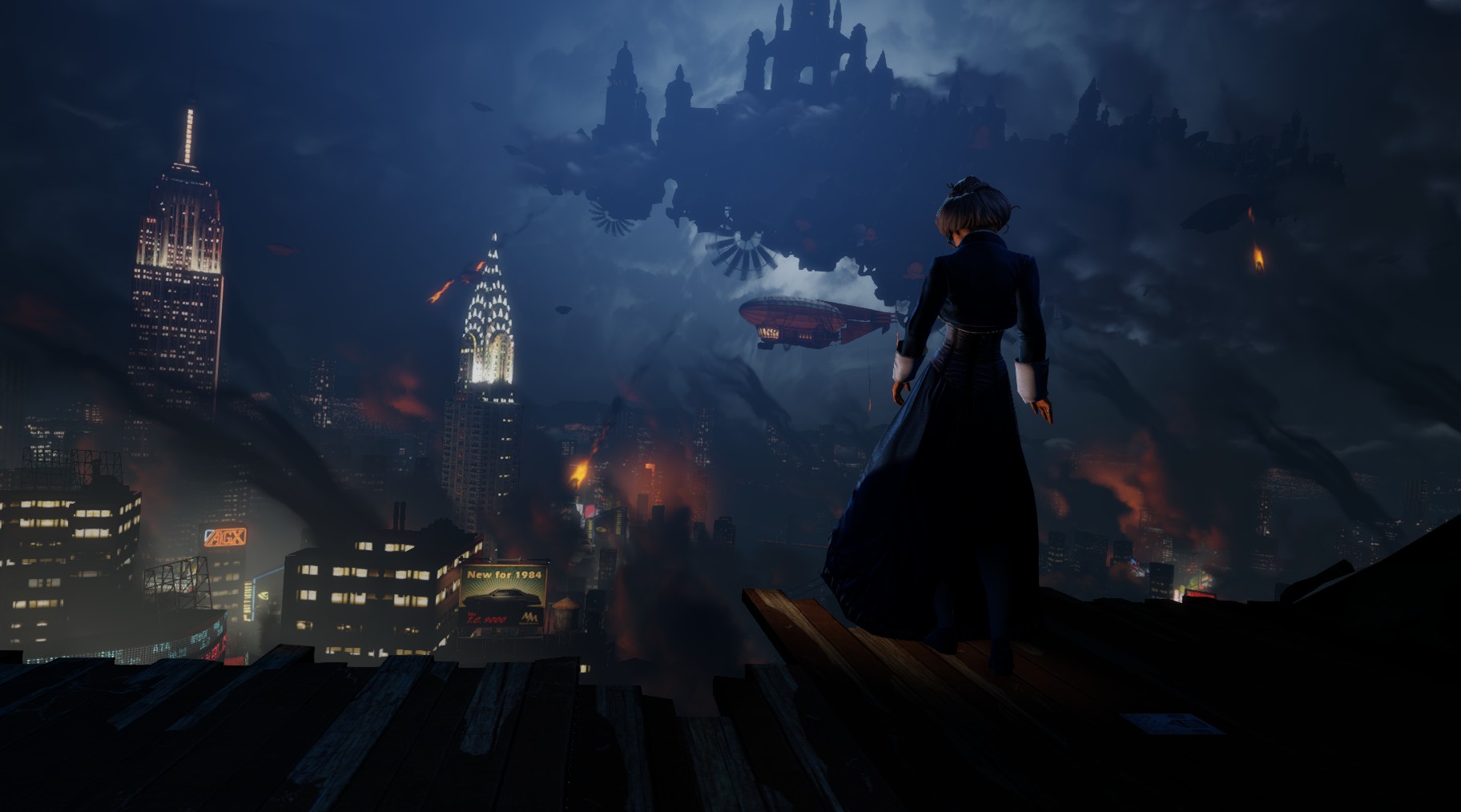
Anna becomes the Seed who Sits Upon the Throne, and Drowns in Fire the Cities of Men. New York burns and the world is left in a state of chaos.
Death is Only the Beginning
The Luteces, though dead, are alive. As they repeatedly tell us during the course of the game: Lived, Live, Will Live. Dead, Died, Will Die. Yes, they are dead, but they are also still alive in the past. The Luteces experiments have made them much more perceptive to the changes in time and history than the other characters, and knowing where their fate lies, endeavor to change it. Lutece speculates in one tape that continually moving through universes dilutes and eventually erases a persons individuality. Which is why, by the time we run across them, they act and speak almost identically.
Anyway, they need to stop Comstock from completely wrecking the timeline and the universe with their technology, but much like Booker they can’t change the choices they’ve already made. It has happened and it will happen. The only thing left to do is fling someone else into the equation, a variable that will allow them to change the events of their lives. Booker DeWitt is their variable. Their dialogue suggests that they’ve used Booker countless times already (you can collect audiologs from a universe where he failed), throwing him into different universes trying to find one where he succeeds and undoes the damage they unwittingly inflicted. In a way the Luteces are much like Anna at the end of the game, only far less powerful. Whereas Anna can move through every universe with ease, and see every strand of history and time as a single tapestry, the Luteces are far more limited. They can only see one string at a time, and they’ve been patiently pulling each one with Booker DeWitt, hoping to find the one that will unravel the whole mess. Obviously I can’t answer how exactly this works, and an explanation would likely just ruin the whole story, so in the end just accept that the Luteces have somehow learned to shift through dimensions and enjoy the story.
We finally arrive at the beginning of the game: Booker DeWitt being rowed to yet another lighthouse containing yet another universe. With this context you understand why the two Luteces are arguing during the opening moments, they’ve tried this experiment countless times before and it’s never worked, but like the male Lutece says “Just because an experiment has failed, doesn’t necessarily mean it will fail.”
They drop Booker off at his latest destination and Bioshock Infinite officially begins.
You still with me?
Booker DeWitt, Elizabeth and The Universe
I’ll be covering the events of the actual game in another article, but for the purposes of this article I’m assuming everyone has already played through the game, so I’ll be skipping to the ending that boggled everyone’s mind.
Comstock is dead, Songbird is a scrapheap at the bottom of the ocean, and the Siphon that was limiting Elizabeth’s power is gone. With her powers fully unlocked Elizabeth brings us to the Lighthouse Forest (hey shut up, you come up with a better name for it) representing the infinite entrances to infinite realities. So first of all, how the hell does Elizabeth know how to get here?
Well now we need to go back to one of Lutece’s audiologs, the one where she speculates that the origin of Elizabeth’s powers are the result of the universe attempting to correct itself. Comstock has royally pissed off time and space by fucking with things that were not meant to be fucked with. Perhaps the Luteces are also an attempt by the universe to repair the damage wrought by Comstock’s insanity, allowing them to pull DeWitt from his native universe and using him as a wildcard to try and repair everything. Regardless, something draws Elizabeth to a very specific point in time and space: the river where Booker DeWitt and Comstock both arrived to try and wash away their sins. Comstock went through with it while DeWitt refused. This is a focal point in history where Elizabeth has the chance to eliminate Comstock forever. As Comstock speculates in one of his audiologs:
“Who is the man under the water? Perhaps he is both Sinner and Saint.”
From this point history diverges: thousands of universes are created as Comstocks go on to create the nightmarish dystopias in countless Columbias and thousands of Dewitts go on to rescue thousands of Annas/Elizabeths. Our DeWitt succeeded but the other Elizabeths that appear here seem to indicate that countless others failed. Too many Annas to save, too many Comstocks to stop, and too much pain to erase. They can’t fix all of the infinite universes one at a time.
But here, in this river at this moment in time, they can stop this entire chain of events before they unfold.
And so DeWitt makes the ultimate sacrifice. He allows himself to drown.

Comstock is never reborn, he never crosses the barrier between worlds and Elizabeth is spared a life of pain and isolation.
And that’s what the hell happened.
And why Bioshock: Infinite is awesome.
If you liked this article you should read about:
Bioshock: Columbia vs Rapture
On the philosophical and sociopolitical themes explored by the original Bioshock compared to Bioshock: Infinite.
Bioshock: Forgive my Infinite Sins
My personal interpretation of the main theme of Bioshock: Infinite; why forgiveness is key to living a healthy life.
Drowning in Columbia
AKA: Why Booker Could Drown in a Cup of Water.



 The Writer's Block
Leave a reply to Yoyoma Cancel reply