I’ll admit I was a bit wary of playing Telltale’s The Walking Dead season 2 for the same reason I was wary of The Dark Knight Rises, I was afraid that the second season wouldn’t be able to live up to the original. I’m happy to report that my fears were proven wrong and that not only does The Walking Dead: Season 2 live up to the original game, but in many ways it’s superior to the original. It manages to correct the few mistakes from the last game, and tells a story even more riveting than Lee’s… the story of Clementine.
Obviously this review is going to contain spoilers so, you know, don’t read it if you haven’t played it. Which you totally should.
The Walking Dead: Season 2
A Storyteller’s Review

When last we left Clementine, she’d just finished blowing Lee’s brains all over the wall in one of the most emotional finales I’ve ever encountered in a video game. Season 2 begins with Clementine tagging along with Omid and Christa as they make their way north. Who are Omid and Christa? If you, like me, hadn’t played the first season of Walking Dead in a while you probably won’t remember these two. They were introduced late in Episode 4 and thus didn’t get as much screen time as the more memorable characters. Don’t worry though, they’ll be dead before you really have to worry about remembering them. Also like me, if you’re missing your savegame from Season 1, not importing a save doesn’t have any significant impact on the story as far as I can tell, so feel free to dive right in.
It’s been about a year and a half since the events of Episode 5 of Season 1, and Clementine is now bigger, more mature and, let’s face it, a bit more disturbed. After Omid is killed by some stupid teenager looking for an easy score, Christa blames Clementine for his death. Though personally I would be blaming the two adults who thought it was a good idea to leave a 9-year-old alone in a zombie infested wasteland. Anyway after one the most intense chase scenes I’ve ever played through, Clementine falls into a river and is swept away by the current, leaving behind a horde of walkers and the thugs that tried to kill her.
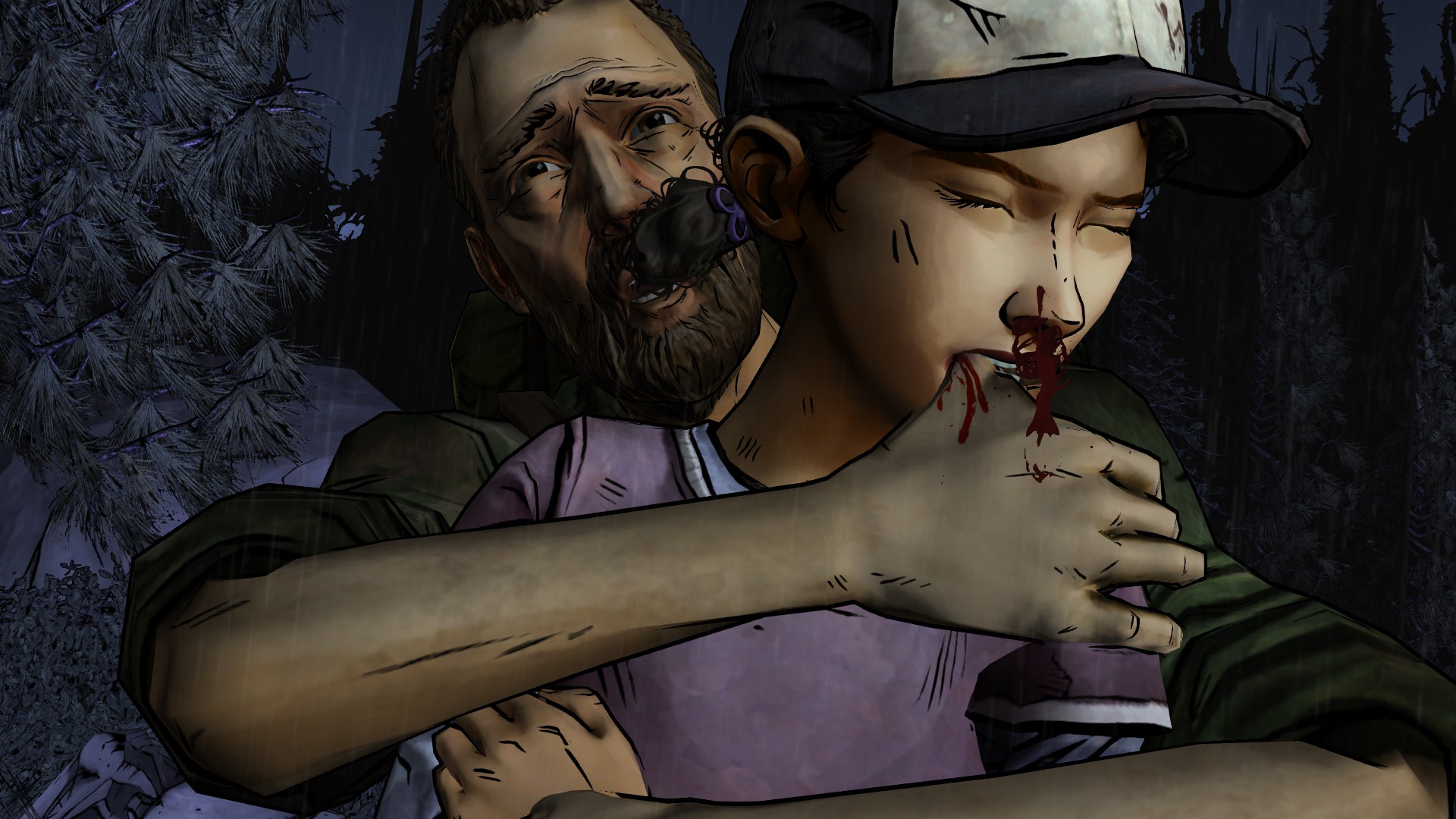
This is where the story really begins, with everything before providing the inciting incident; Clementine finds herself alone, unarmed and with no supplies in the middle of a forest with winter fast approaching. Fortunately Clementine finds herself a new friend:

Together Clementine and her new Canine companion go on many magical adventures; playing fetch, scavenging for supplies, and sharing a meal. Oh the good times I imagined me and my new friend would have together. Just me and my faithful dog against the scary, zombie-infested world. Soon we’d…we’d…
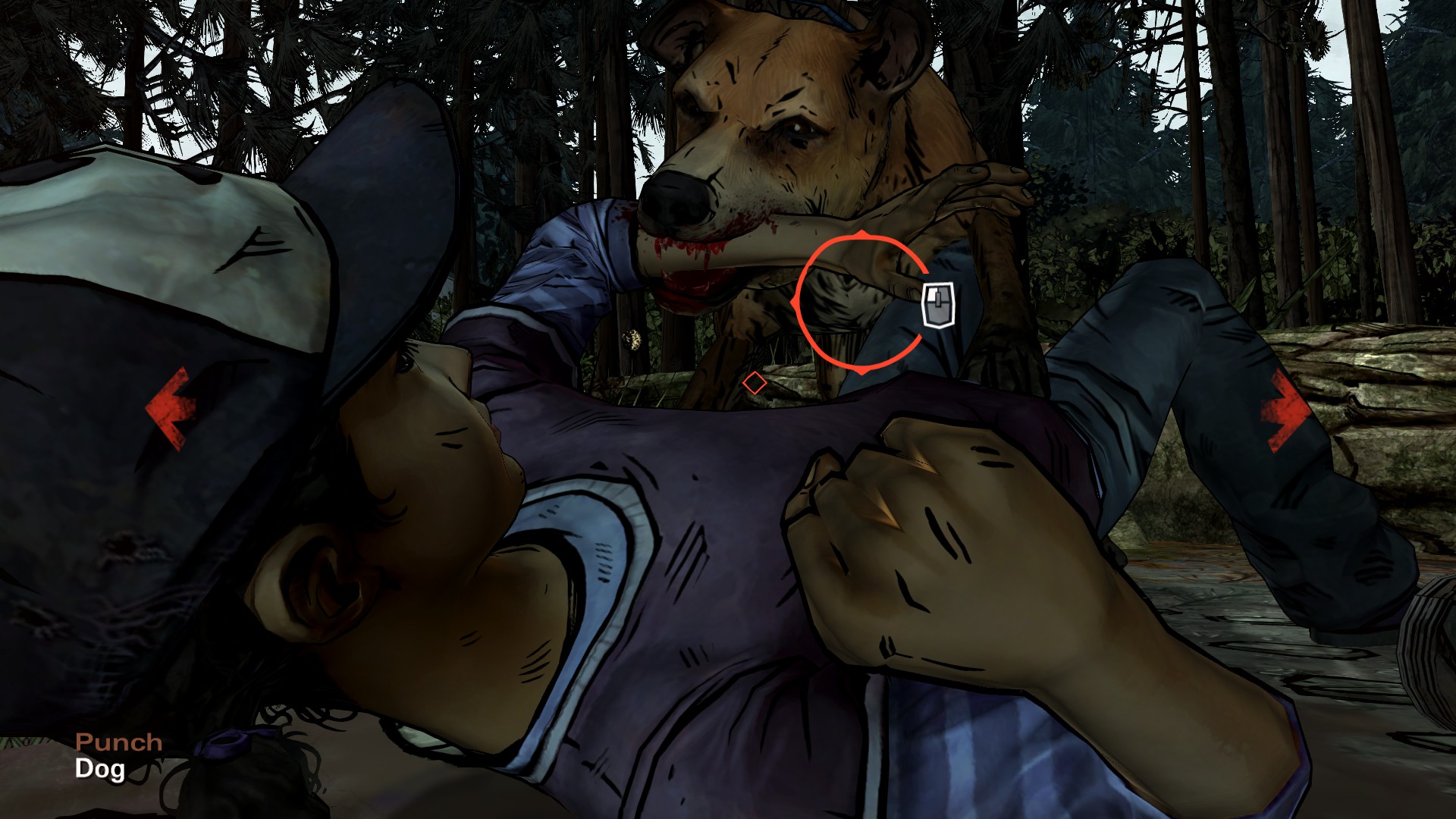
This scene shocked me on so many levels. When I was taking Creative Writing at the local college, my teacher told me a very specific fact about dogs and stories, a fact that I’ve never questioned.
You can have your protagonist kill men, women, even children and still have your audience rooting for your character. But the minute your character kills a dog, say goodbye to your readers.
I’ve always found this to be true, and apparently so do many other writers, because you never see a hero killing a dog. If you see a dog die in a story, it’s almost always a result of either the villain’s actions or environmental factors. This is mostly because dogs are often always the heroes in stories, even the powerful Dire Wolves of the Song of Ice and Fire series are seen as heroic companions rather than the apex predators they are. That’s not surprising considering that canines have been our loyal companions for thousands of years. This scene with Clementine though, is probably the most realistic depiction of dogs I’ve seen in a video game.
In the right conditions any one of us would turn into a heartless, cold blooded killer. We’re all predators, but because we live in comfort with readily available sources of food, safety from the elements and disease, we’ve suppressed the instincts that have made us such efficient killers. Dogs are no different, in a loving environment with food, warmth and safety, dogs are one of the most loyal and dedicated friends you could ever ask for. Throw a dog into the cold, deprive it of food, put it in constant danger and isolate it from people, and they will quickly revert to their most basic instincts: that of the wolf. That’s what happened to this dog. To its credit it was friendly for most of the time, but once Clementine found that food, the dog’s overwhelming instinct for survival took over.
It’s a credit to the people at Telltale that they so brilliantly lured you in with the dog’s pleasant demeanor, we trust dogs almost implicitly and they used that trust to shock us with this powerful scene. When a story needs to reinforce the stakes of a story, reiterate the harsh realities of their world, most of them will kill off a human character. That’s a fine way to do it, but Telltale’s decision to use this dog instead was simply…brilliant. We love dogs, and to see what many of us consider to be our closest friends, reduced to a wild animal willing to kill a little girl over a can of beans, that reinforced the stakes of the story in a way that shocked our sensibilities. It told us that the world we live in was truly gone. That dog dragged Clementine to the ground and dragged us into harsh, unforgiving reality of her story.

I wanted to be angry at the dog, but I couldn’t. I understood why it attacked me. I chose to kill the dog, not because I was seeking revenge, but because the dog deserved mercy. I wasn’t about to let it spend hours in agony slowly bleeding to death. With a tearful goodbye I forgave the dog and ended its suffering.
That’s just the first fifteen minutes of the first episode by the way, and it does an absolutely terrific job setting the stage for the rest of the game. In fact the dog represents a microcosm of the story itself; will you become like the dog? Will you put your survival above all else, even at the expense of other people’s lives? Or will you try to hold onto your humanity?
Obviously this isn’t the first story to explore such questions, but exploring those questions through the eyes of a 11-year-old girl makes this one of the most riveting and compelling explorations of these themes. While most stories shy away from showing children in pain, The Walking Dead takes an almost perverse pleasure in not only making you watch her suffer, but making you work with her through the worst pain she’s ever experienced.
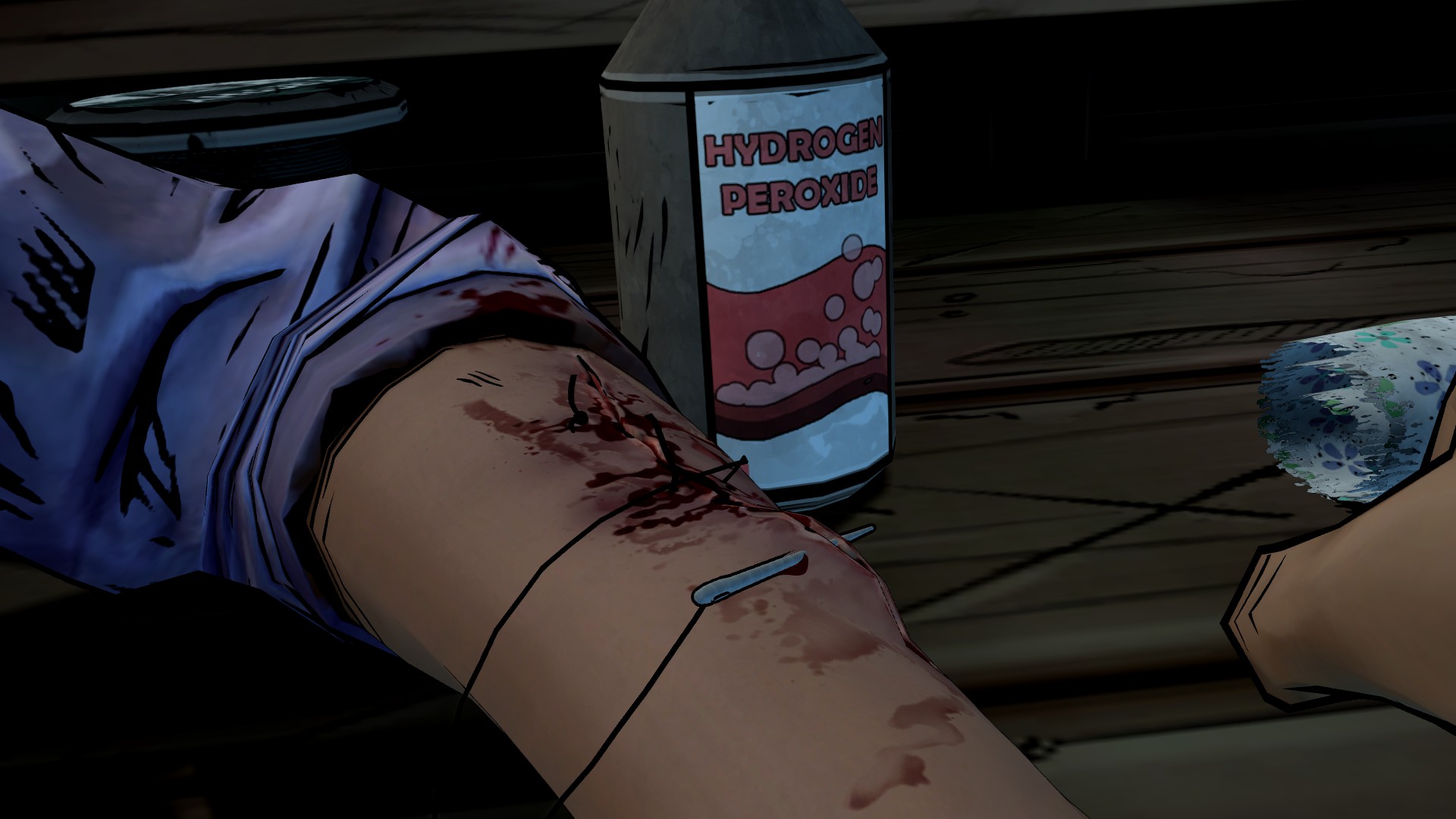
Holy shit this sequence was crazy, absolutely crazy. The game shows you, in excruciating detail, Clementine disinfecting and stitching shut her gaping wound by herself. The dickheads she meets up with are convinced the arm wound in a zombie bite, so the stupid bunch of cowards go and lock her in a storage closet to see if she turns. I was ready to see all of these idiots die horribly because they pissed me off. Who leaves a little girl to die in a utility shed? Really guys? What the fuck is wrong with you?
Once again though, Telltale never makes things simple for you, and as you get to know this new group of survivors, you’ll not only understand their decision but will in all probability forgive them for leaving you to die in a drafty old shed. And yes, once again, it’s these characters that make this game so incredible.
All of the problems I had with the previous Walking Dead season have been completely eradicated in this one. There are no more forgettable characters like Omid and Christa, each and every character you meet in this game will stick in your memory. Even the ones that die only moments after you meet them.
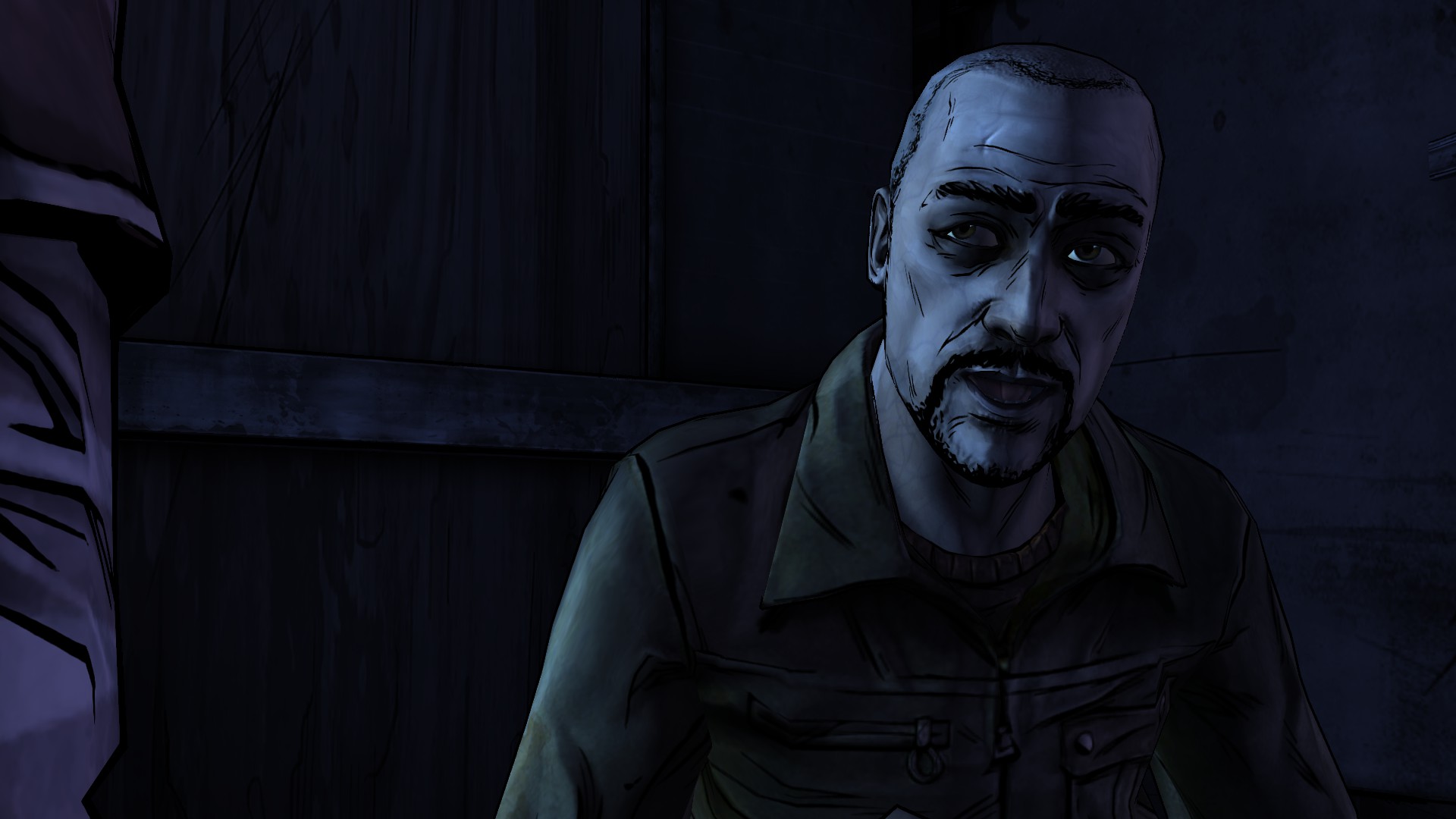
My biggest gripe from the first season came in the form of the Walkie-Talkie-Baddie, the strange villain that came out of nowhere and served no purpose than to give you an overwrought overview of your actions over the course of the game. This time there is no impossible to explain villain and no contrived kidnappings; it’s just you, your company of survivors, and the hard decisions you have to make in order to survive. Also, unlike the ending of the first season which railroaded you towards the ending, you get some time to rest and appreciate the characters you’re travelling with.

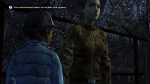
This scene around the campfire is yet another great example of juxtaposition, I was smiling and laughing right alongside my companions, especially when Luke began talking about his sexual escapades with Jane.
I just wanted to forget about everything for ten minutes. – Luke
Ten minutes? Hell I wouldn’t last that long at this point. – Mike
Well, okay, maybe not ten minutes. – Luke
That’s gross. – Clementine
It’s a puerile sex joke, and in any other context wouldn’t be that funny, but after the stress of surviving zombies, crazy Russians, and a mentally unravelling Kenny, it was the funniest thing I’d heard all day. For a few moments, while huddling around the fire and listening to people laughing, I thought maybe this group would be okay. That maybe we’d all survive. Maybe everything would be alright.

Luke falling through the ice and drowning proves to the final straw for this group of survivors. Kenny, who has been becoming increasingly unhinged since the death of Sarita, is ready to kill Arvo and leave the rest of the group behind if necessary. Alvin Jr. (AJ), the newborn of Rebecca, has become an obsession with Kenny. His entire reason for living becomes wrapped up in the survival of the child and he begins seeing anyone who doesn’t agree with him as a threat to the kid’s survival. Mike, Bonnie and Arvo are completely terrified of Kenny, and I can’t say I blamed them. What I can blame them for is shooting Clementine before running off into the forest. Though perhaps she should thank them, because after being shot, Clementine wakes up in the arms of a familiar friend.
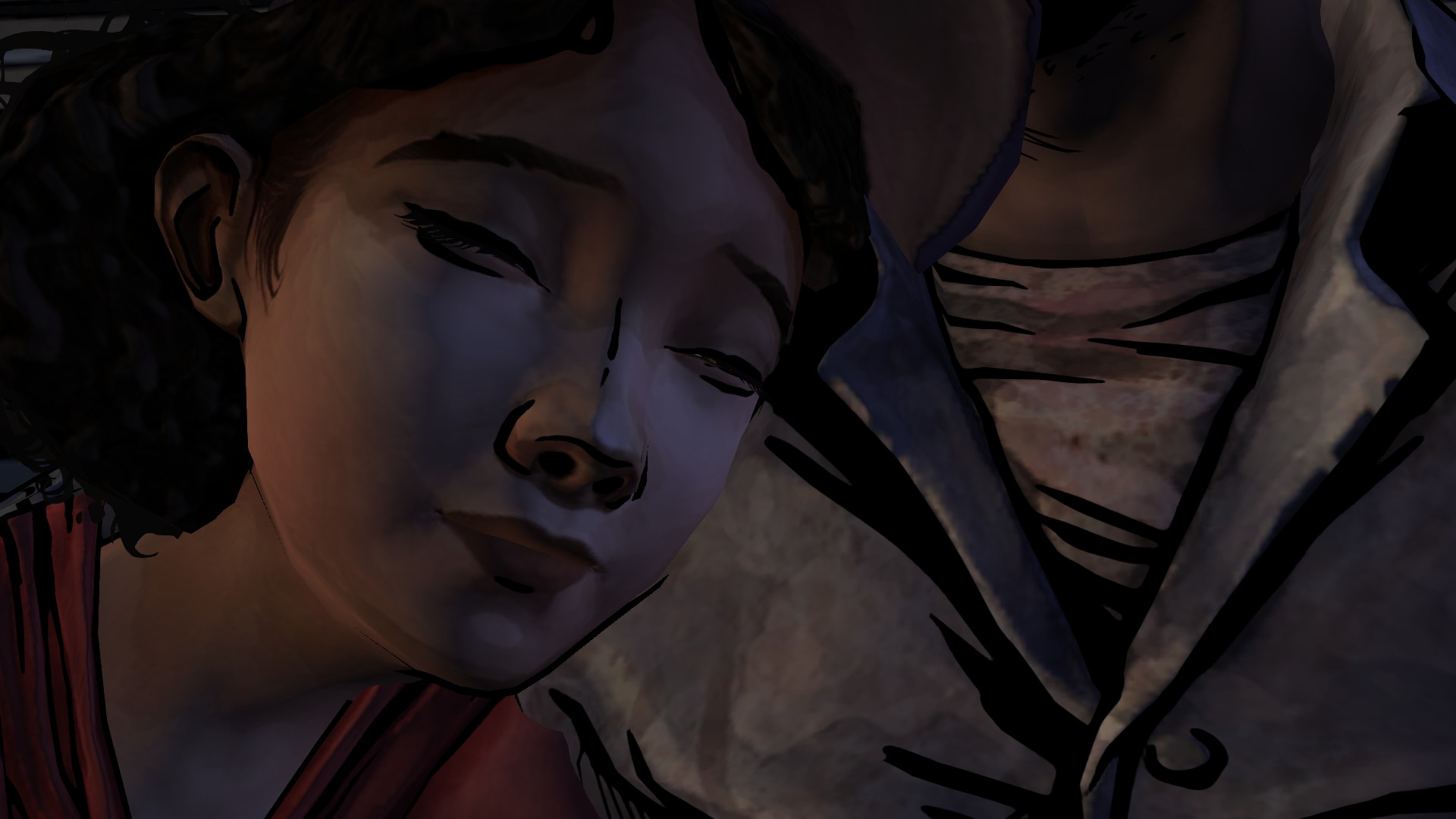
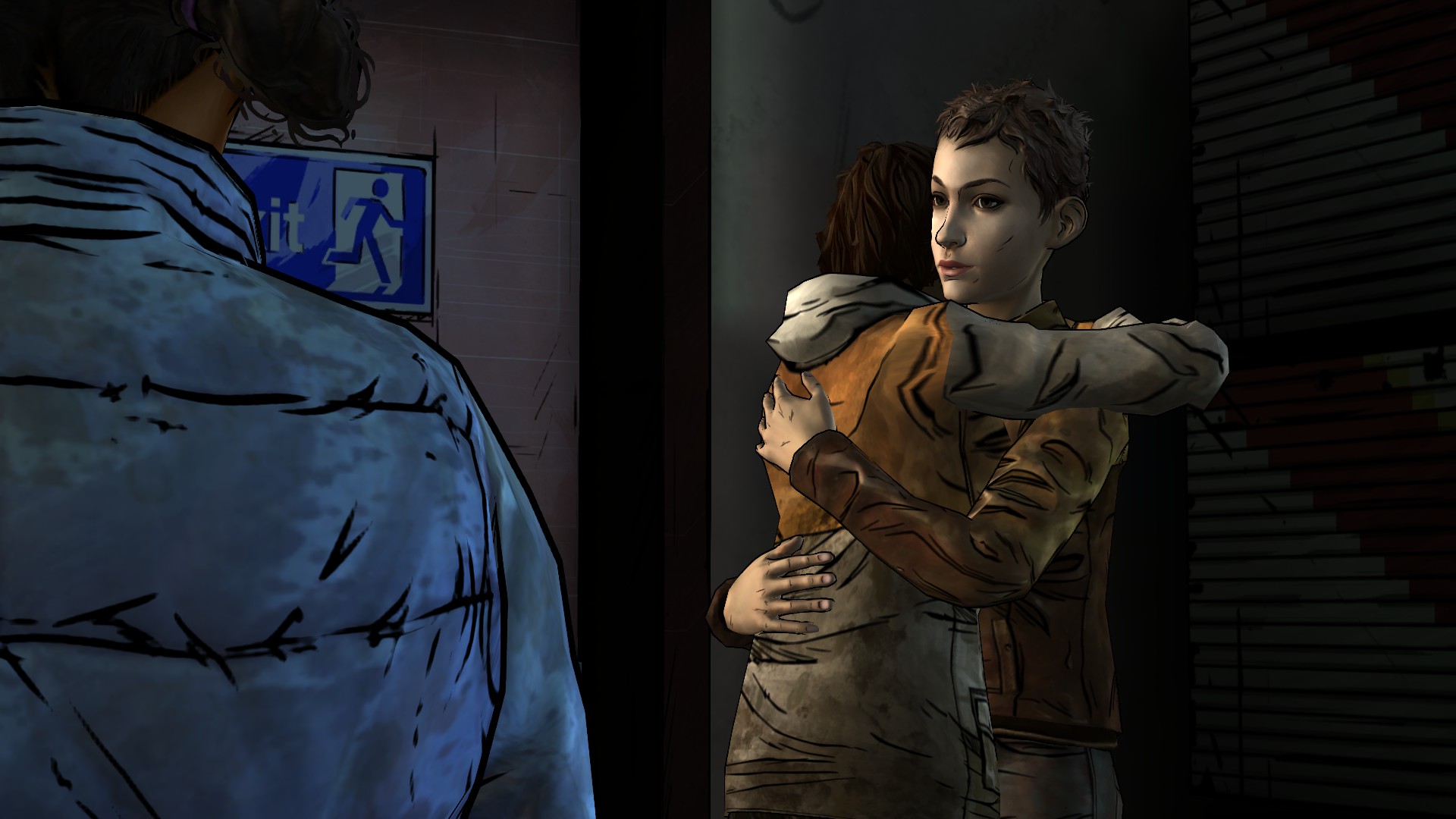
 It was good to see Lee again, I didn’t realize how much I’d missed his character until this scene. Clementine’s mind, reeling from the shock of a bullet tearing through her shoulder, retreats to the last moment when Clementine felt safe. This scene gives us not only a much needed break from the constant stress of survival, but a valuable glimpse into Clementine’s subconscious. As much as she’s grown, as much as she’s proven that she can care for herself, inside she’s still a little girl. Inside she wants what we all want, to feel safe and loved. It’s a nice scene that reminds us that, even though Clementine has killed more than her share of Walkers, and even a few human beings, she’s still a child. A child who just wants someone to tell her it will be alright.
When Clementine regains consciousness she finds herself in the truck that Kenny managed to get started, with Kenny and Jane arguing over their next course of action. Kenny wants to continue searching for Wellington, an almost mythical sanctuary at this point that might be more rumor than fact, while Jane wants to head back south to Carver’s old base where they know supplies are being kept. It’s clear a choice has to be made, Kenny and Jane are both too stubborn and shortsighted to put aside their differences, leaving Clementine to make the decision.
After getting separated in a Blizzard they regroup at a rest stop, but when Jane arrives without AJ Kenny finally loses his tenuous grip on reality and goes completely crazy. Like any good narrative, this scene hearkens back to the scene with our dog friend. I trusted Kenny, he’d been a good friend, but a person can only take so much before he’s irrevocably broken. Sarita’s death was Kenny’s breaking point. I tried to reach him, to pull him back from the edge. Like the dog who attacked Clementine though, Kenny was beyond reasoning when he attacked Jane. Finally… he left me choice.

To my surprise, the bullet lodged in Kenny’s hip seemed to make him a bit more lucid, and he forgave me for shooting him. The man who only a few minutes ago was prepared to stick a knife in a girl’s heart…finally seemed at peace.
I’ve asked for this for so long… and now that it’s here… I’m scared. – Kenny
You’re going to see Duck and Katjaa… – Clementine
You always were good for a smile… – Kenny’s last words.
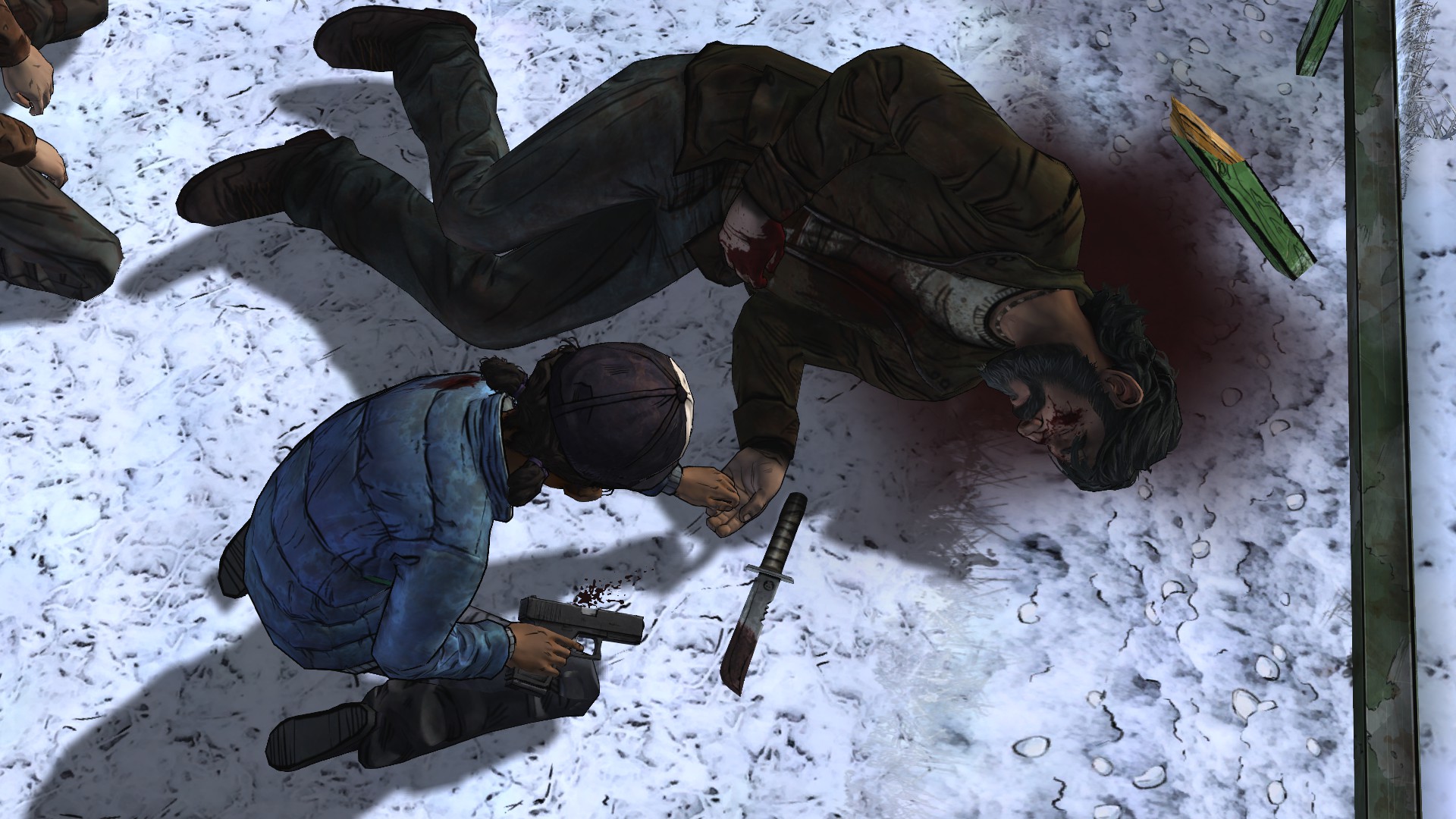
Saying goodbye to Kenny was just as emotional as saying goodbye to Lee in the previous episode, and this time it wasn’t tainted by an inexplicable villain. The finale of episode 5 ranks as one of the finest endings in any video game ever, and Telltale once again shows us what a powerful storytelling device video games can be. The Walking Dead may not always be good for a smile, but it’s always good for an incredible journey. And it’s a journey I urge you to undertake because it’s one of the finest, most emotional journeys you’ll ever take inside a video game. It may be filled with tragedy, loss and darkness…


 The Writer's Block
Leave a reply to prom.ua Cancel reply