
The Witcher 3: Wild Hunt is a thing that exists and that alone is a miracle. After everyone rushed to pile awards at the feet of Dragon Age: Inquisition, a game that was mediocre in every sense of the word, I was beginning to feel like no one gave a damn about stories anymore. After spending nearly a hundred hours in the world of the Witcher 3 though, I can say that this is one of the best RPG’s I’ve ever played. This game is everything Dragon Age Inquisition should have been, everything it promised and failed to deliver, was delivered in spectacular fashion by The Witcher 3: Wild Hunt.
The open world is mind blowingly huge, and unlike Dragon Age Inquisition, there are no artificial boundaries that turn the maps into a series of corridors. You can cut through the middle of a forest or swim across a lake, just beware what lurks within. You never know when Nekkers will crawl up out of the ground around you, or you’ll be sailing along minding you’re own business or riding along on your faithful steed when a Griffon will swoop down and rip off the top half your torso.
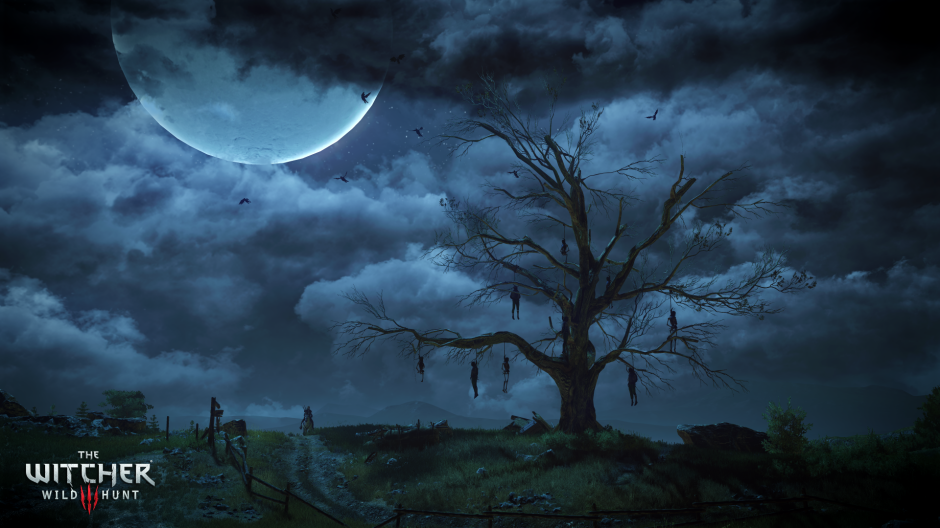
Your choices have real consequences, some that are immediately apparent and others that won’t reveal themselves until you’ve nearly forgotten about the choice you made…only to have the stark consequences slap you in the face. Every single choice yo make has a consequence. At the beginning of the game I met a scholar who wanted to write about the war between Redania and Nilfgaard. I told him to go for it, tell the real story of the war. The next zone I entered, I found that scholar’s corpse dangling from a tree; hanged on suspicion of being a spy.
But most importantly, the story is one worth experiencing. It’s not about some evil sorcerer trying to conquer the world or finding a plot McGuffin, it’s about characters. There are no pointless side quests in this game and no collecting ram meat for nameless refugees. Everything matters and everything tells you a story, and they’re all worth the telling.
That concludes the spoiler-free portion of my review. If you don’t want the story spoiled for you turn back now, just trust me when I say this is a story you won’t regret having experienced. What Game of Thrones did for television (completely redefining what’s possible for the medium) The Witcher 3: Wild Hunt does for video games.
The Witcher 3: Wild Hunt is the game I’ve been waiting to play all my life.
The Witcher 3: Wild Hunt
A Storytelling Review
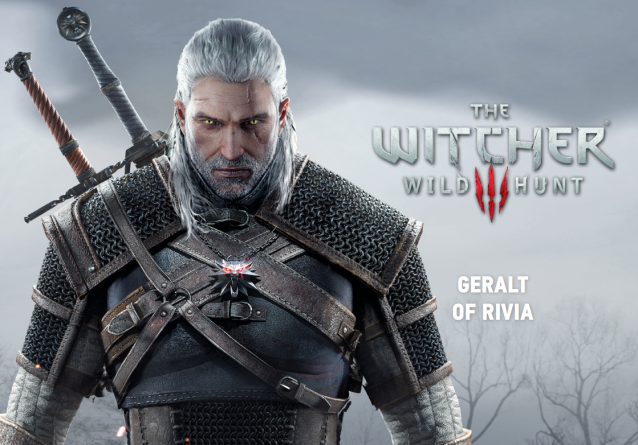
The world of the The Witcher is George R. R. Martin’s Game of Thrones meets high fantasy. There are elves and dragons and magic, but this is no Tamriel or Middle-Earth. It’s a world of political intrigue and brutal warfare inhabited by monsters drawn from mythology of every culture. Yet of all the monsters you’ll fight in this game, none will be so monstrous as man himself.
The story follows Geralt, the titular Witcher, as he tries to find his old ward Ciri. The Witcher 2: Assassin’s of Kings made reference to Ciri, as well as Geralt’s former lover Yennefer, but they were so vague that none of it seemed all that important. The Witcher 3, however, does an absolutely astounding job with the characterization. Every single character feels alive and you’ll come to love each and every one of them, or love to hate them as the case may be. As you experience Ciri’s life through a series of flashbacks, you’ll become just as eager to find her as Geralt, if only because she’s so incredibly badass.
At first I was afraid this was going to turn into a “princess in the tower” scenario where you have to rescue Ciri from danger. But basically most of the story is spent chasing her because Ciri keeps rescuing herself before Geralt can even get there.

Ciri is being pursued by the Wild Hunt, considered a legend by most and a wraith by those who’ve seen him, but who Geralt and Yennefer know is very real. The Wild Hunt is a huge monstrosity of an elf from a parallel world, who is able to cross between worlds and is desperately seeking a way to save his world from destruction. Of all the characters, the Wild Hunt is the only cipher among them, he’s not really characterized at all and so he comes across as a bit of a stereotypical villain. He’s basically The Witcher 3’s Corypheus, only his boss fight is actually climactic and difficult, so even the weakest link in this game’s story is infinitely stronger than Dragon Age Inquisition’s entire chain. His part in the story is extremely small though, as it should be, and the focus is on the amazing characters you’ll meet.
Most of the game is spent trying to pick up Ciri’s trail and piece together her story from the peoples she’s met along the way. First all this is a brilliant way to do a story in an open world environment, because it lends itself to the exploratory nature of the game’s world. There’s an urgency to finding Ciri, but at the same time it’s not the same urgency as trying to stop an apocalypse. It makes sense that Geralt would choose to take on a monster contract while scouring a village for clues to Ciri’s disappearance. It starts making less sense once you find Ciri, but by that time I’d finished most of the side quests, and the main quest had become so intriguing that I rushed through to the end of the story. But I’m getting ahead of myself.
The game has an impeccable sense of pacing, for instance after a long arduous journey finding Ciri’s trail and finally deducing that Uma is the key to finding her, you have a chance to get some real work done: Drinking. Along with your fellow Witchers, Lambert and Eskel, you get the opportunity to relax. I can’t tell you how fun this scene was, but after what must have been 20 or 30 hours spent hunting Ciri and witnessing terrible atrocities in that time, this was exactly what I needed. Most importantly you remain in control and in character the entire time. So if you’re playing Geralt as a straight up professional, you have the choice to go to bed early. The game doesn’t just jump to a cutscene, and by doing that you feel completely immersed in the experience.
Now I’ve never developed a taste for alcohol, it just tastes so awful I can’t drink enough to get drunk, so I have no idea what it’s like to get drunk. Thanks to the Witcher 3 though, I feel like I really did get blind drunk and dress up in a frilly frock, because the scene was just that expertly written and presented. I felt like I lived it myself, it was that good. I also nearly broke a rib laughing.
The writers know how to craft a story, because after every major event and heart rending moment, there was moment to balance it out. The Battle of Kaer Morhen was quite possibly one of the most intense battles I’ve ever played in a video game. It’s just a handful of defenders against dozens of the Wild Hunt’s warriors, and yet the small number of combatants did nothing to detract from the pure epicness of the siege. In fact the small number of defenders made me feel like everything I was doing was absolutely vital.
More importantly, I knew the who each of the defenders was. There were no faceless, nameless defenders being killed in a failed attempt to raise the stakes like most video games. No, I knew the face and name of everyone fighting by my side, they we’re people to me, and that made every moment of the siege feel real. My heart was in my throat the entire time. And when Vesemir gave his life to save Ciri, I felt the same rage Ciri felt.

But back onto the point of pacing, directly after this incredible scene, the writer’s wisely decided to give us an opportunity to laugh. This is absolutely vital to any good story, because if it’s all horror and death the audience will grow numb to it and eventually bored of it, that’s something the Witcher 3’s writers understood. After a somber funeral scene and a few days to recuperate, we’re treated to a snowball fight between Ciri and Geralt. Again the incredible people at CDProjekt knew the best way to tell this moment was to leave the player in charge, so it’s you charging around exchanging snowballs with Ciri.
And when you’ve slain the Crones of Crookback Bog and avenged Vesemir by killing the Wild Hunt’s general Imrelith, you share a tender moment of peace while watching the sunrise. That’s the other great thing they did with Ciri’s character, they didn’t fall into the trap of making Ciri a badass by draining her of emotion. She laughs, cries and rages like every other person in the story. She’s human.
And it’s in these interactions with Ciri that Geralt is best revealed. Once again you remain in complete control, you can choose to not have a snowball fight with Ciri and play it cool and distant. But though you may not know it now, even these small moments have huge consequences on the story.
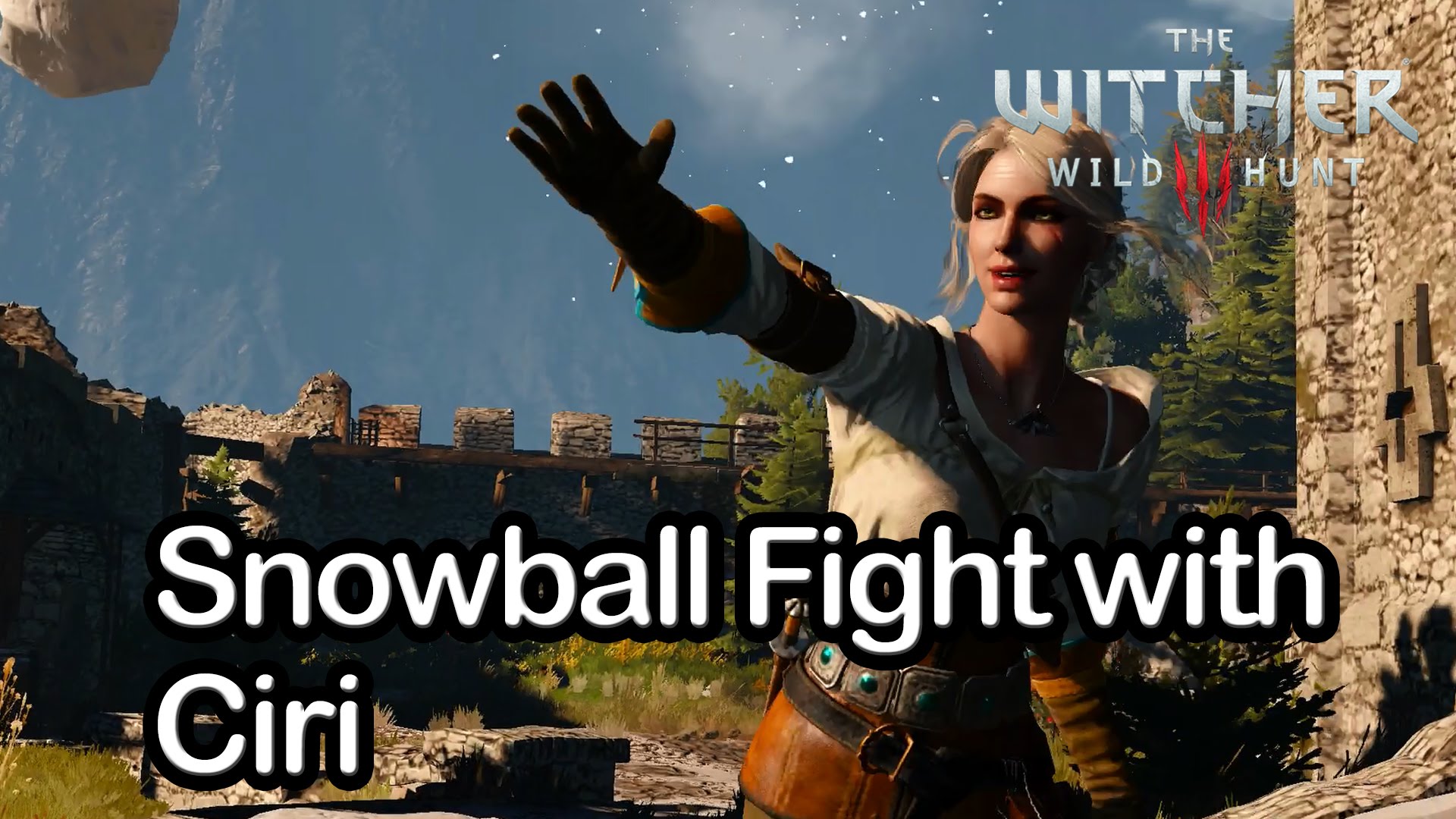
My friend also played through the game and played almost the exact opposite Geralt, a pure professional who did only what was necessary. He didn’t have a snowball fight with Ciri, he didn’t gleefully smash up Avallac’h’s lab, and he didn’t let Ciri lay to rest Skjall (the man who led Ciri to safety in Skellige). In his ending, Ciri had disappeared and was presumed dead.
In my ending, as my Ciri stared into that strange energy field from which the White Frost was coming, in her mind’s eye flashed all the great moment’s we’d shared throughout the game’s story. The snowball fight, the lab, and the visit to Skjall’s grave where she told the villagers of his heroism. The moments that reminded her that there were things worth living for.
And she came back.

Again the brilliance of the conclusion is that I still retained control, I was the one who had “Sparrow” inscribed on Ciri’s new silver sword, and rode to meet her at the Inn in White Orchard where this whole story first started. When I talked about emotional closure and the importance of resolution in the Story Arc in my Mass Effect 3 and Dragon Age Inquisition reviews, this is exactly what I was referring to. A few brief moments when we can relax and allow the story to come to an end, like the last trailing notes of a grand symphony.
“Well then, let’s try it out…” – Ciri to Geralt
Then of course we’re also given the slideshow ending that answered any unanswered questions and gave us resolution to the interesting, yet ultimately unimportant subplots such as the Nilfgaardian invasion. Much like Game of Thrones, The Witcher 3 dangles fascinating political stories for you to focus on that ultimately have nothing to do with the actual plot. This is a story about characters, and the slideshow tells you what became of the people you came to love.
Geralt spent a few months with Ciri teaching her all he knew of the ways of the Witcher, and then they parted ways, with Ciri going on to become a Witcher even more famous than Geralt. And as for Geralt himself?
He retired to Kovir with Triss, taking on occasional monster contracts, but for the most part living out the rest of his life in the peace that had eluded him for so long.
That was my story. My choices in the game led me to an ending that left a warm glow in my heart, and was one of the most satisfying experiences I’ve ever had in a video game. And if you haven’t already, get out there and start your Geralt’s story because no matter how it ends up, you’ll never forget the experience.


 The Writer's Block
Leave a reply to John Stevenson Cancel reply