
This was a difficult post to write. There’s just so much wrong with this game’s writing that I had a hard time organizing my thoughts. I’ll need to do several follow up articles to cover everything that went wrong with it, but suffice it to say that the glitchy gameplay and hilariously bad facial animations aren’t the only things wrong with Mass Effect: Andromeda.
Which is a shame because I wanted to like this game, I really did. It sounded like my fantasy Star Trek game, exploring and communicating with strange new alien species while commanding my own starship. Unfortunately Mass Effect: Andromeda is not a sequel to Mass Effect…
It’s a remake.
A poorly done remake at that.
Rather than take their clean slate and create a new Mass Effect universe, Bioware instead has opted to simply retell the same stories we’ve already seen but without the nuance and skill that made the originals so memorable.
[[Spoiler’s to Follow]]
All That Matters is the Ending:
Mass Effect Andromeda

As I said before, there are just so many problems that I’ve had to limit this post to the top three problems I felt were the most crippling.
Here are those three problems and why they derailed what was Bioware’s last chance to impress…
1. Ryder’s Dialogue is Awful

There’s so much wrong with the dialogue in this outing of Mass Effect that I can’t possibly squeeze it into this review and a thorough dissection of what went wrong will be coming soon. However, I do want to point out one huge problem with the dialogue that cripples Mass Effect: Andromeda‘s every attempt at creating any kind of drama:
Ryder doesn’t care.
Or if he does, the dialogue doesn’t inform me of his feelings, which is basically the whole point of dialogue. Ryder’s dialogue is often completely inappropriate for the dramatic situations he finds himself in.
The biggest example is during a raid on the Archon’s ship after it has captured the Salarian Ark. Ryder discovers the remains of dozens of Salarians who have essentially been vivisected and their organs removed while they were still alive. An atrocity straight out of the darkest periods of human history.
I had been completely indifferent until this point, Mass Effect: Andromeda hadn’t managed to evoke a single emotion from me. But now, finally, I was pissed. It was the first time I felt genuine hatred for the Kett because it was the first time Andromeda showed me why I should hate the Kett, rather than simply telling me.
At one point I passed by an observation window where two Kett scientists were still operating on a Salarian. Vetra and Jaal, my companions for the mission, began beating on the glass, with Jaal roaring with rage and threatening to kill every last Kett on the ship. At this point I was pumped, my face was actually hot with anger, and I was ready to slaughter every god damn rock-faced alien on the ship with my bare hands.

Shortly after that, Ryder and company found a Krogan who had been Exhalted, and finally I was given a chance to hear Ryder’s opinion the matter. I chose the casual option, thinking this would allow him to vent his anger in a profanity laden oath to crush the Kett.
“I’m really starting to hate these guys.” – Ryder, after seeing Nazi-style medical torture and experimentation.
That was his response to the horrors he’d witnessed. Ryder wasn’t angry, if anything he just seemed slightly annoyed at seeing the atrocities being committed around him. All of that anger I felt, the first actual emotion the game had succeeded in drawing out, evaporated in an instant. The complete nonchalance of Ryder destroyed Andromeda‘s own dramatic tension. And this is ultimately a problem that crops up again and again.
I understand wanting to differentiate Ryder from Shepard, and in many ways I do enjoy how less sure of himself Ryder is, but making the character less self-assured doesn’t mean lobotomizing the characters emotions. Ryder never yells, never cries, rarely laughs, he seems utterly incapable of expressing any strong feelings. The result is that the dialogue completely hamstrings the emotional scenes in the game. When Jaal finds out about the origin of the Kett, I wanted to express sympathy. To reach out and grab him, tell him we would find a way to help or make the Kett pay for this atrocity, but instead I was limited to four tepid options, each more bland than the last.
There are a handful of scenes that have an interrupt option, but even these seem tame compared to the old Paragon/Renegade interrupts of Mass Effect 2 and 3. When you first meet Peebee, you’re given the option to push her off. Except that’s not really what the character does, you just sort of gently move her aside. Even when given an old school renegade interrupt in shooting the Cardinal at the Kett base, Ryder does it with such indifference that it loses all impact.
While I appreciate the effort to get away from the Paragon/Renegade system, the new system is ultimately too shallow to do anything with the roleplaying part of this RPG. First of all, the categories are way too nebulous and vague, what I would consider an emotional response is far different than what Ryder would end up saying every time I picked that category. Secondly, Ryder often ends up saying something completely different to what you’d expect based on the prompts you’re given. And finally… no one really seems to care what you have to say anyway.
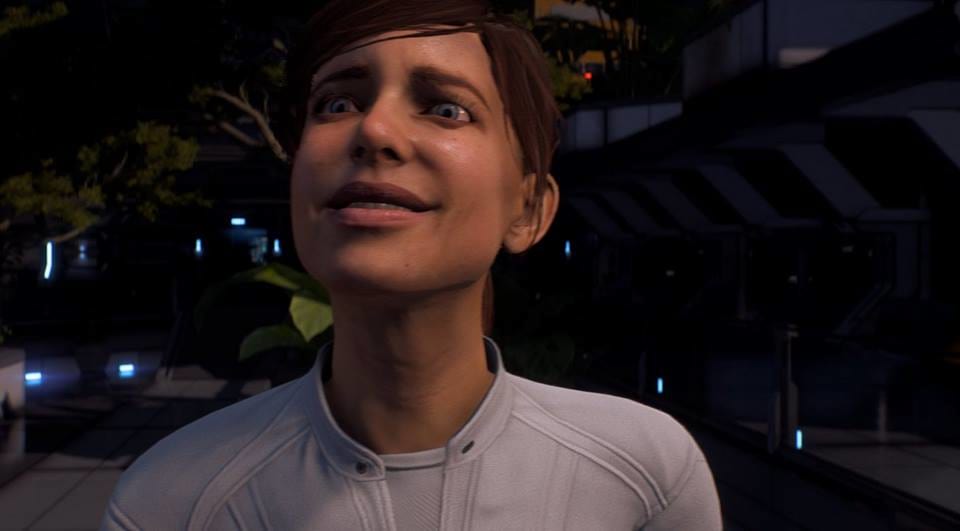
The most jarring part of the game I’ve encountered came at the very beginning, just before taking off in the Tempest. Liam asks Ryder how he’s holding up, and one of the responses is to be honest and tell Liam you’re having a hard time with your father’s death. Ryder says something to the effect of “I hear voices, and not just SAM’s,” or something like that.
And Liam has no response. The camera just zooms out slowly while Ryder and Liam stand there in the most awkward silence possible. I really hope someone has a video of this sequence, because it’s the most unintentionally hilarious moment in the entire game. Like on a certain level it almost works because what can you say when the last best hope for humanity admits that maybe he’s losing his mind. Yet it does nothing for furthering the characters of either Ryder, who never brings up the emotional toll of his father’s death again, or Liam, who you think would report such a conversation to the doctor or at least offer some words of encouragement.
The story of Ryder slowly losing his mind to grief might actually have been an interesting story to explore, but unfortunately it doesn’t because –
2. Andromeda Focuses on the Wrong Stories

Andromeda not only had the potential to give us a new take on Mass Effect, but also sold itself on that very concept. Yet time and again, they opted to simply retell the same stories from the original trilogy instead. I mean if this wasn’t made by the same company as the originals, this would be blatant plagiarism.
It starts with a fledgling humanity trying to find its place among the stars, there’s a big bad threatening to destroy humanity (the Kett) and lurking just beyond is an unknowable horror threatening to destroy the galaxy at large (the Scourge). There’s an ancient precursor race wiped out by a mysterious force. Your companions are a Krogan, a Turian, a male and female human, the Quarian is now an Angaran, and of course Ryder is the new Shepard.
It’s not like there weren’t plenty of other, better stories right there in front of them. For instance, let’s talk about Drack.
Drack has an enjoyable story and he’s likable enough, but ultimately he’s a pale imitation of Wrex. His granddaughter Kesh, on the other hand, could have made for a much better Krogan ally, allowing us to get a new perspective on the Krogan. Kesh is a Krogan that’s defined by her intelligence and her wits, rather than her savagery, and I would have loved getting to know her better. Kesh’s character and history was a story worth the telling

Even how Andromeda tells the story of the Krogan species is a retelling of the original Mass Effect. The Krogan again come to the rescue of the other species, only this time it’s mutineers instead of the Rachni, only to be once again completely screwed afterwards. There was a much better story to be told right there in front of them in the form of the Nexus’s first year and its battles with the Kett.
The Krogan could have been the heroes of this new frontier, in fact Eos would have been the perfect habitat for them considering their resistance to radiation and its similarities to Tuchanka. Drack and his squad of scouts were already destroying the Kett handily when you first meet up with him, in fact the Kett are just fragile little gemstones compared to the walking tanks that are the Krogan. Instead of having yet another story of Krogan humiliated and defeated, we could have had a story about a Krogan race resurgent and triumphant.
There were a dozen different ways to tell this story, Andromeda was offering a fresh start, but instead of writing their own story they simply traced over what was written there before.
The biggest wasted potential of Andromeda is in how it utterly failed to build on its own premise. I was genuinely excited by the prospect of exploration and discovery becoming the cornerstone of this new Mass Effect, it sounded like my fantasy Star Trek game, going to distant worlds and discovering new civilizations. I expected to find Andromeda alive with species both wondrous and grotesque. Yet exploration and discovery, despite the dialogue repeatedly telling you you’re an explorer, aren’t the focus of the story.

Instead it’s a story about an evil race of aliens trying to wipe out humanity. Only this time the aliens are far less interesting, both visually and narratively, and instead of a charismatic villain like Saren we get the near mute Archon who feels like Corypheus 2.0. The fight against the Kett dominates the storyline, but ultimately I found myself struggling to care about any of it.
You know what I did care about? Finding the missing Arks, building colonies, and exploring the galaxy.
The missing Arks are perhaps the most perplexing part of the narrative, because it’s never made to seem all that important. It’s presented to the player as busy work, something to do while you’re out in case you get bored, but don’t worry yourself over it. If you ask Cora, Kallo, or the Turians about the missing Arks, they all share the same basic indifference.
“Yeah, they’re missing, and we’ll let you know if we hear anything about it, but don’t worry yourself over it.” That’s what it always boils down to, and it did more to ruin my immersion in the story than any other element of the game. Finding the the missing Arks should have been a massive priority, if not because of the humanitarian implications, than at least because of the resources each one contained.
Saying they’re lost and the Nexus doesn’t know where to look is a completely unacceptable attitude for the narrative to be presenting. During the course of the game, you extrapolate the currents of the Scourge to find a centuries old artificial planet floating in deep space. Yet when trying to find the Arks, SAM can’t estimate the Ark’s trajectory based on their final destination? Find out where an Ark would likely run into a Scourge cloud?

The Kett could still have played a role, the closest I came to actually becoming engrossed in the storyline came when I was rescuing the Salarian Ark. Racing to find the Arks before the Kett would have been infinitely more involving than trying to beat them to Meridian ended up being. Instead of yet another race across the galaxy to find an alien artifact before the bad guy, Andromeda could have told the story of finding friends and family amid alien stars.
Building outposts is certainly presented as important by the narrative, but unfortunately the gameplay doesn’t reflect that importance. So many of the quests sounded fascinating on paper; finding out why so many settlers became pirates, hunting down poachers on Voeld, putting to rest the many people who died trying to found colonies. Unfortunately, as interesting as these quests sounded, actually completing them was a chore. Everything devolved into a go to this point and either scan, collect, or kill an objective.
Similarly, while getting a planet to the minimum viability rating took time, once an outpost was settled it was instantly completed. I wasn’t expecting to build my outposts into bustling metropolises like Ilium, and in fact I actually like how large the outposts are, I just felt cheated that they start out that size. Huge satellite dishes, shield generators, sensor arrays, and dozens of buildings all show up over night. It would have been more rewarding had the outposts started with a smattering of buildings and slowly grown larger as you complete quests for the colony.
Finally, Andromeda suffers from the same problem as every other sci-fi franchise that’s tried to reboot its property in a different galaxy: the new galaxy is boring. This seems to be such a common failing that its hard to blame the relatively inexperienced writers of Andromeda for failing this test. Voyager’s Delta Quandrant was a lifeless wasteland whose only permanent species was the Borg, and Stargate Atlantis’s new galaxy held only Space Vampires and the Not-Space-Vampires. Similarly, Andromeda’s Heleus Cluster is home to only the Angara and the Kett.

Mass Effect’s Milky Way was teeming with varied and interesting lifeforms, all with fascinating quirks and physiology. While on subsequent playthroughs I saw how Mass Effect 1’s first Citadel section had pacing problems, my first visit I didn’t even notice them because I was engrossed in getting to know all the different species and rich history of the universe. Talking with the Elcor ambassador and learning their species’ charming speaking patterns is one of my favorite memories of the original trilogy. Andromeda feels utterly devoid of life by comparison, not only are there only two species, but those species aren’t even properly fleshed out.
Every Angara I went through went through great pains to tell me how big their families were, as if the writers were hoping that one trait alone would be enough to curry interest in their new aliens. It’s not. Meanwhile the Kett are religious extremists, but we never find out any meaningful details about what they worship or why.
And all of this eventually comes together to ruin what could have otherwise been a serviceable ending.
3. It’s Ending is Rushed and Unearned
Unlike Inquisition’s pitiful final battle with Corypheus, where he essentially falls over dead with little fanfare, Andromeda at the very least delivers a visually spectacular battle that could have been very satisfying. Unfortunately, the ending is completely let down by the fact that narrative never earns such a colossal battle. I’m going to pull out an old school picture from my first review of Mass Effect 3.

I pulled this out during my initial Mass Effect 3 review to illustrate how the ending had failed to provide a falling action and resolution. This time I’m pulling it out to illustrate how Mass Effect: Andromeda failed to create the rising tension necessary for a good climax.
To be fair, the original Mass Effect could suffer this problem too. If you didn’t do Virmire as your final mission before the ending, finishing up whatever main quest was left could feel like busywork by comparison. However, by Mass Effect 2, Bioware had managed to nail an almost perfect curve for their rising action.
Over the course of Mass Effect 2, the stakes of the story slowly ramp up and that’s reflected in the action. From the slower first act where Shepard begins to uncover the Collector’s identity and plans, to the second act aboard the seemingly derelict Collector ship, and finally the crescendo of the Reaper’s attack on the Normandy and the Suicide mission. The rising action was so finely tuned that it never felt like it was rushing through the story, nor did it ever feel like it was being unnecessarily padded.
Mass Effect: Andromeda‘s story somehow managed to feel both incredibly padded and extremely rushed at the same time. The rising action serves several important purposes; setting the stakes of the story, revealing the villains abilities and goals, and gradually ramping up the action. Unfortunately it failed to do any of those things.
The stakes of the story are never clearly defined. In a broad sense, the very survival of humanity is at stake, but it’s not enough to simply tell us that. The story needs to provide specific threats to human survival. They even try to throw your twin in there as something at stake, but since the twin has only a handful of lines, we never get to feel emotionally invested in that character. Human survival has been the stake of every Mass Effect game, but this is the first time I never felt any actual danger from the villains.

Much like Corypheus from Dragon Age: Inquisition, the Archon never establishes himself as a credible threat to either humanity or Ryder. The plot was constantly telling me I was in a race against time, but I never felt that was the case. Where as Saren was fully capable of finding the Conduit and using it, the Archon was consistently unable to use even the most basic of the Remnant’s technology. What’s the rush? The guy has been banging his head against this thing for who knows how long, I really don’t feel like time is a factor.
Meanwhile the Kett at large, unlike the Reapers or Collectors, never become the larger-than-life villains they pretend to be. Ryder’s small team manages to wipe out multiple Kett bases all by themselves, they never attack any of the incredibly soft targets that are Ryder’s new outposts, and the Angara continue to resist them centuries after first contact. The only points in the Kett’s favor are their genetic manipulation and the strange mind control they use.
If this had been the first time Mass Effect had shown us a villain that can genetically manipulate species and dominate their minds, that might have gone a long way to making the Kett a credible threat. However, just like everything else, this a story that’s already been told by the original Mass Effect. The Reapers did it all to a much more effective degree than the Kett.
Not that the Kett couldn’t get there, they could have if the story had been allowed to breathe a little. Andromeda was just hitting its stride when I was rescuing the Salarian Ark, and at the time I thought that was about the midpoint of the story based several factors:
- The stakes had been significantly raised by threatening the extinction of the Salarians in Adromeda.
- The Kett became far more threatening due to how close they came to wiping out the Salarians.
- The action was by far the most intense of the story.

However, rather than build on the momentum this mission built, Andromeda opts to launch straight into its endgame. An incredibly boring endgame at that, taking place inside the derelict hull of a Remnant superstructure. Visually the levels are nice to look at, but narratively they actually reduce the stakes of the game. Instead of giving us people to save, and cool characters to put in danger like the Salarian pathfinder, without something at stake other than “get to point X”, there’s no thrill. No danger.
No fun.
No, I take that back, I did get a good laugh out the ending sequence.
When the Archon launched into a “I let you win” speech after activating Meridian, I laughed out loud, it was just such a ridiculous idea. This bumbling, incompetent moron who has been pawing at inert pieces of rock trying to activate Meridian suddenly becomes this mastermind and it just destroyed by suspension of disbelief. Like Mass Effect 3’s ending, in which the Citadel suddenly appeared over Earth because reasons, the Archon seizes control of the Hyperion and abducts your twin. How he even knew there was a twin is a question that was never answered.
The hijacking of the Hyperion also punches some rather large holes in the already flimsy plot. For instance, the Nexus had been hanging there in a near crippled state for nearly a year before Hyperion shows up, why have the Kett not attacked it before now? The ending also glosses over exactly how the Kett boarded the Hyperion while it was moored to the Nexus. Do none of those ships, or the Nexus itself, have any kind of defensive armaments?
Finally there’s the one choice that seems to actually affect the ending, whether you had all the pathfinders. I was just tired of all the fetch quests by the time I reached the ending and couldn’t be bothered with another “go to point A and scan object B” mission, so the Turian Ark went undiscovered. As a result, Captain Dunn died.
My response to that?
“Who the hell is Captain Dunn?”
I had met Captain Dunn at the very beginning of the game, which was near forty hours earlier, and once or twice for a couple of side quests. I was never given an opportunity to know her as a character. I mean I obviously clued into the fact that she was the Hyperion’s captain, but that fact alone doesn’t mean her sacrifice is going to have any kind of emotional impact. It’s as if Bioware saw how much everyone loved Captain Anderson’s final moments, and decided that it was the label of Captain that everyone loved rather than the character himself.
In the end the story was just too rushed for the ending to have any kind of weight to it. In fact the whole game feels rushed. Somehow, despite having five years to work on it, it was rushed. Or perhaps simply overly ambitious.
Either way, I really wanted to like this game. Unfortunately it ended too soon and left me asking only one question:
What was the point of it all?


 The Writer's Block
Leave a reply to Amylianna Cancel reply